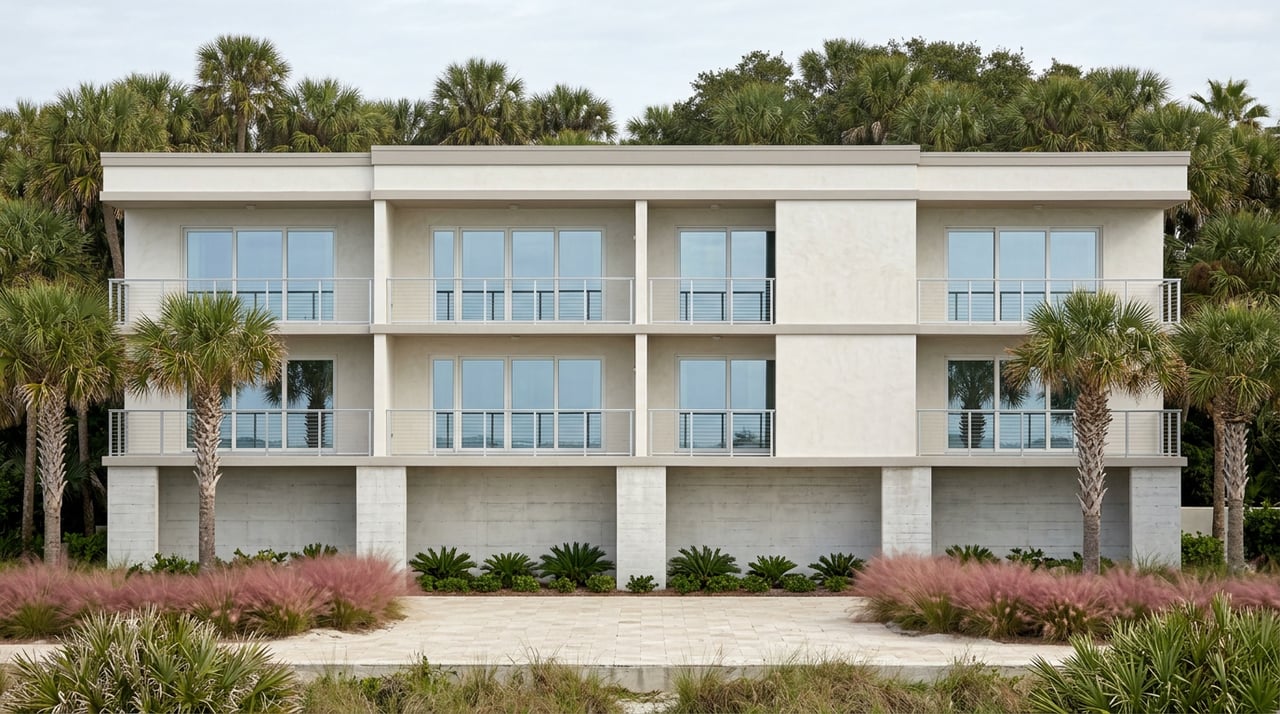
Panama City Beach Condo Assessments: What Buyers Miss
September 10, 2026
September 10, 2026
In March 2025, the owners at Dunes of Panama Building A opened a letter that changed what their condo actually cost. The seven-story tower went up in 1974 on Front Beach Road, and the board had just approved a $1.6 million special assessment to cover it. The bill landed unit by unit: roughly $22,000 for a small two-bedroom, $36,000 for a larger one, payable in full or on a schedule the association set. Nobody who bought there in 2020 or 2022 saw that number anywhere on the original listing sheet.
That's the part the citywide median never tells you. Panama City Beach's market numbers get quoted constantly this year: a median sale price of $383,770 for the three months ending in May 2026, down 4.1 percent from the same period the year before. That figure is accurate, but it averages a 1974 concrete tower catching up on decades of deferred reserves with a 2021 build that's already fully compliant with state law. A buyer comparing two condos at the same list price this year isn't comparing two similar products. They're comparing two different bets on when the next assessment letter arrives.
For decades, Florida condo boards could vote every year to underfund or skip reserve contributions entirely. It kept monthly dues low and made older buildings look cheaper to own than they actually were. The 2021 collapse of Champlain Towers South in Surfside ended that option. Senate Bill 4-D, passed in 2022, requires any residential condo building three stories or taller to complete a Structural Integrity Reserve Study at least once every ten years, and it eliminated the board vote that used to let associations waive reserves for structural items like roofs, load-bearing walls, plumbing, and waterproofing.
The timeline is what makes 2026 the year this actually lands. Associations that existed before mid-2022 had to complete their first reserve study by the end of 2025. Reserve waivers for budgets adopted after December 31, 2024 are no longer allowed under Florida Statute 718.112, and even boards that squeezed in a waiver before that deadline still have to start funding their required reserves on January 1, 2026. This isn't a future compliance date anyone can push off. It's this year.
Here's what that's looked like on the ground in Panama City Beach:
| Building | What Happened |
|---|---|
| Dunes of Panama Building A (built 1974) | $1.6 million special assessment approved March 2025; roughly $22,000 to $36,000 per unit |
| Ramsgate Condominium (built 1985) | Special assessment approved May 2025 for Gulfside balcony replacement, concrete repair, and water-damaged wall repair |
| Twin Palms Condominium | $5,815 special assessment, collected in three installments |
| Ocean Villa Condominium | 2026 post-season painting project expected to add a $5,000 to $8,000 per-unit assessment, following a prior project that cost $700,000 |
| Pinnacle Port Condominiums | 2025-2026 budget passed without reserve study funding, board paused contributions citing House Bill 913 |
Once assessments started landing, the legislature added a pressure valve. House Bill 913, passed in 2025, lets associations take out lines of credit for reserve-required repairs instead of collecting a lump-sum assessment all at once, and it created a narrow path for temporary reserve pauses under specific conditions. That's the provision Pinnacle Port's board leaned on when it paused reserve funding for its 2025-2026 budget.
The relief buys time. It doesn't buy an exemption. The underlying obligation is still on the books, and a paused reserve line this year usually means a larger catch-up assessment or a steeper dues increase later, not a bill that quietly disappears.
Florida's condo disclosure rules also give buyers a window to review the association's records and walk away without penalty. The clock starts counting from the day you actually receive the governing documents, not the day the contract goes effective, and the exact number of days has shifted more than once in the past few years. Confirm the current window with your agent or attorney rather than assuming last year's rule still applies.
What matters more than the count is what you do with it. The records you're entitled to include the milestone inspection report, the reserve study or a written statement that one hasn't been completed, and documentation of any current or anticipated special assessments. A good agent requests these three items before you write an offer, not after, so you know what you're actually buying before that clock even starts. If a seller can't produce a milestone inspection or reserve study for a building that's clearly old enough to need one, that gap is information on its own.
Not every price gap on the same building is about risk. In August 2025, a two-bedroom unit at Ocean Villa Condominium sold for $450,000. Two weeks later, a unit with the identical floor plan on the 19th floor sold for $469,000. Both carry the same monthly dues and the same exposure to the building's upcoming painting assessment. That $19,000 difference is floor and view, not reserve health.
Buyers need to hold both kinds of number in their head at once. Consider Calypso Condominium, where a two-bedroom unit with a bunk room sold for $705,000 in the third quarter of 2025, the highest per-square-foot price in the building that quarter. The same unit type sold as a preconstruction contract for $425,000 in 2006, went through foreclosure for $218,000 in 2011, sold again for $475,000 in 2021, and was remodeled before the 2025 sale. Four prices, one unit, and none of it moves in a straight line with any citywide median.
Before putting two condos side by side on price alone, build a short list:
The Panama City Beach headlines this year are real: prices softening, supply climbing, buyers gaining leverage. But that number is an average of buildings that no longer have much in common. A 1974 tower catching up on forty years of deferred reserves and a fully-funded 2021 build can list two blocks apart at nearly the same price and cost their owners very different amounts over the next five years. The question worth asking isn't what the unit is listed for. It's what percentage of the reserve study is actually funded.
A few things buyers ask along the way
Can I ask the seller to cover an existing special assessment? Yes, and it's routinely negotiated, either as a price reduction equal to the assessment or as a seller credit at closing. Get it written into the contract itself rather than treated as a verbal understanding with the listing agent.
Does a special assessment affect my ability to get a loan? It can. Lenders review an association's reserve funding, litigation history, and rental concentration before approving a building for conventional financing. Weak reserves or a large recent assessment can push a project onto the non-warrantable list, which usually means a portfolio loan with different terms.
How do I find a building's reserve study or milestone inspection report before I write an offer? Ask your agent to request it directly from the seller or the management company. Associations above a certain size are now required to post governing documents, budgets, and reserve studies online, so more of this is becoming visible before you're even under contract.
If you're weighing a Gulf-front tower against a newer build, or trying to figure out what a specific building's reserve numbers actually mean for your monthly cost, that's the kind of digging worth doing before you fall for a price that isn't the whole story. Jennifer Drew - Main Site works the documents building by building across Panama City Beach and the wider Emerald Coast. Let's Connect and go through the real numbers together.
Stay up to date on the latest real estate trends.
Jennifer is dedicated to helping clients navigate every step of the process with honesty, local expertise, and personalized service.